Modern generosity from business to the breakfast table
IN THIS EMAIL
To share or not to share
ROI without the dollar signs
Bad service for kingdom impact
To Share or Not to Share
Image credit: Gospel Patrons
Have you ever been excited to share about the impact of your giving but hesitate? Maybe you recall Jesus’s warning: “…when you give to the needy, do not let your left hand know what your right hand is doing” (Matthew 6:3).
John Rinehart, Founder of Gospel Patrons, posted an excellent discussion about whether Christians should, as a rule, give anonymously. In fact, he outlines biblical reasons in support of talking openly about it.
How do you decide when to remain anonymous and when to give publicly? Below are a handful of questions that may be helpful to consider.
What is your main motivation?
The why matters. The apostle Paul instructs, in no uncertain terms: “Do nothing out of selfish ambition or vain conceit. Rather, in humility value others above yourselves, not looking to your own interests but each of you to the interests of others” (Philippians 2:3-4).
If the strongest pull for you to announce your gift is to encourage others to give, volunteer, or advocate, sharing can be incredibly productive. You may be able to increase the organization’s visibility and draw more attention to their activities.
However, if you sense the tug of recognition or validation, anonymity may be wiser.
Does the nonprofit have better ideas?
Before independently sharing anything, you may want to check in with the nonprofit. Often, teams are working behind the scenes to develop email blasts, website copy, social media content, press releases, impact reports, and other materials to strategically tell their story.
Raising support is a critical aspect of any organization’s efforts, and the nonprofit likely has an opportunity to weave your giving into their ongoing communications. Your willingness to collaborate can translate into even greater impact for the nonprofit.
There may not be a right or wrong answer about publicizing your charitable giving; the decision can be tricky. John Rinehart’s article offers more considerations for a biblical approach. And, as James encourages, “If any of you lacks wisdom, you should ask God, who gives generously to all without finding fault, and it will be given to you” (James 1:5).
A charitable contribution is, in most cases, a financial investment with a non-financial, non-personal return. That can make it harder to understand exactly what that money is doing.
A nonprofit’s annual report can give you an initial, high-level look. There, you should find overviews of operations, finances, and strategy. For an organization that demonstrates transparency and accountability, providing general support is a great way to advance the work being done at every level.
However, you may want to designate your gift. Maybe a unique project or location speaks to you; maybe the organization has made a special request; or maybe you want to get into the weeds to vet a new or new-to-you nonprofit. In that case, you may want additional ways to anticipate your ROI.
Here are just a few of the elements that help demonstrate the non-financial return on investment — measurable impact and meaningful change — of your gift.
Quantitative Returns
Outputs are the results of activities done. Examples include number of people reached with the gospel, meals provided, health screenings completed, workshops or trainings conducted, etc.
Outcomes are the changes that took place. These could look like increased technology access, higher graduation rates, reduced homelessness or food insecurity, etc.
Impact describes broad, long-term change and shows lasting effects on individuals, communities, or systems. For instance, a gift might lead to reduced poverty rates, improved quality of life, stronger community infrastructure, etc.
Qualitative Returns
Case Studies tell the story of an individual, family, or community, detailing the challenges they faced and how the project contributed to their success.
Testimonials offer accounts of the grant’s impact from a firsthand point of view, helping supporters see through the eyes of the people served.
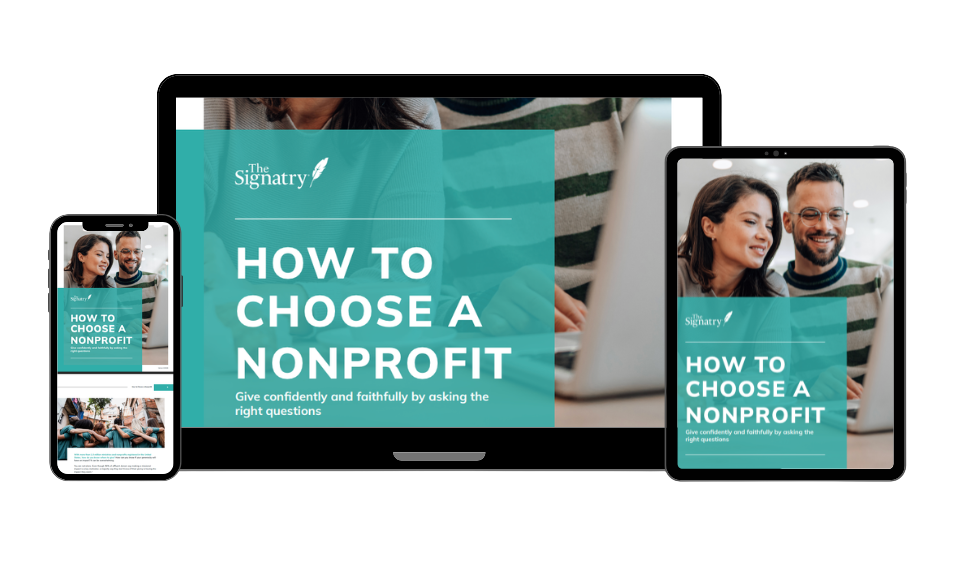
If you’re looking for more guidance on how to evaluate a nonprofit or specific project and whether it fits into your vision for generosity, you can follow the steps in our free guide, How to Choose a Nonprofit. It includes more green flags to look for and a list of questions you can ask the organization’s representatives directly.
Like any investment, a charitable gift assumes some risk. Returns are not guaranteed. However, knowing what to look for can help you decide which gifts are worth the risk.
“Time. Talent. Treasure.” These are resources we all have available for generosity and impact.
When I was in grad school, debate arose among my peers about how to do the most good in the world. Sure, volunteering is great—but if you have high earning potential, shouldn’t you allocate all your time to making money so you can give more away?
That math seemed elegant to me.
My then-roommate, one of the smartest and most faithful Christians I’ve ever met, disagreed. “If all you’re giving is money, how is God shaping you?” she asked. “How is he forming your heart if you’re so disconnected?”
Lifeway Research shares a similar view in their State of Discipleship study. They argue that service to others—generosity with our time—helps us “move from consumption to contribution.” Service activates other spiritual disciplines because it’s outwardly focused, inherently inconvenient, and often uncomfortable.
Not to mention that service was a hallmark of Jesus’s life and ministry. To follow in his footsteps is to serve others.
Generosity with your financial treasure is a clear biblical call, and sharing your money can be a highly efficient, practical way to love your neighbor as yourself. (I’ve already spoken about my affinity for direct cash grants.) For most readers of this newsletter, it’s likely that the biggest, most measurable kingdom impact you can make is to give money.
However, generosity with your time is just as clear a call. You may feel like the small amount of time you have to give won’t make a difference. You may, like me, feel kind of inept in most volunteer settings. But giving your time—especially if it’s your scarcest resource—will do the most to disciple you to live like Jesus.
As a disciple walking ever closer to Jesus, who knows what impact you will make.
It’s not a choice between giving money and giving time as I was tempted to think, not even if you could make a bigger difference with just one. Giving your time to others is how God will shape you into the kind of person he created you to be.
This does not constitute nor does The Signatry provide legal, tax, financial or other professional advice. You should consult professional advisors concerning the legal, tax, or financial consequences of your charitable activities.